Hardware: the specification that has to exist before the quote
Brand and series decide door thickness, drilling and price. A quote without them is a range, and the range is where projects get lost.
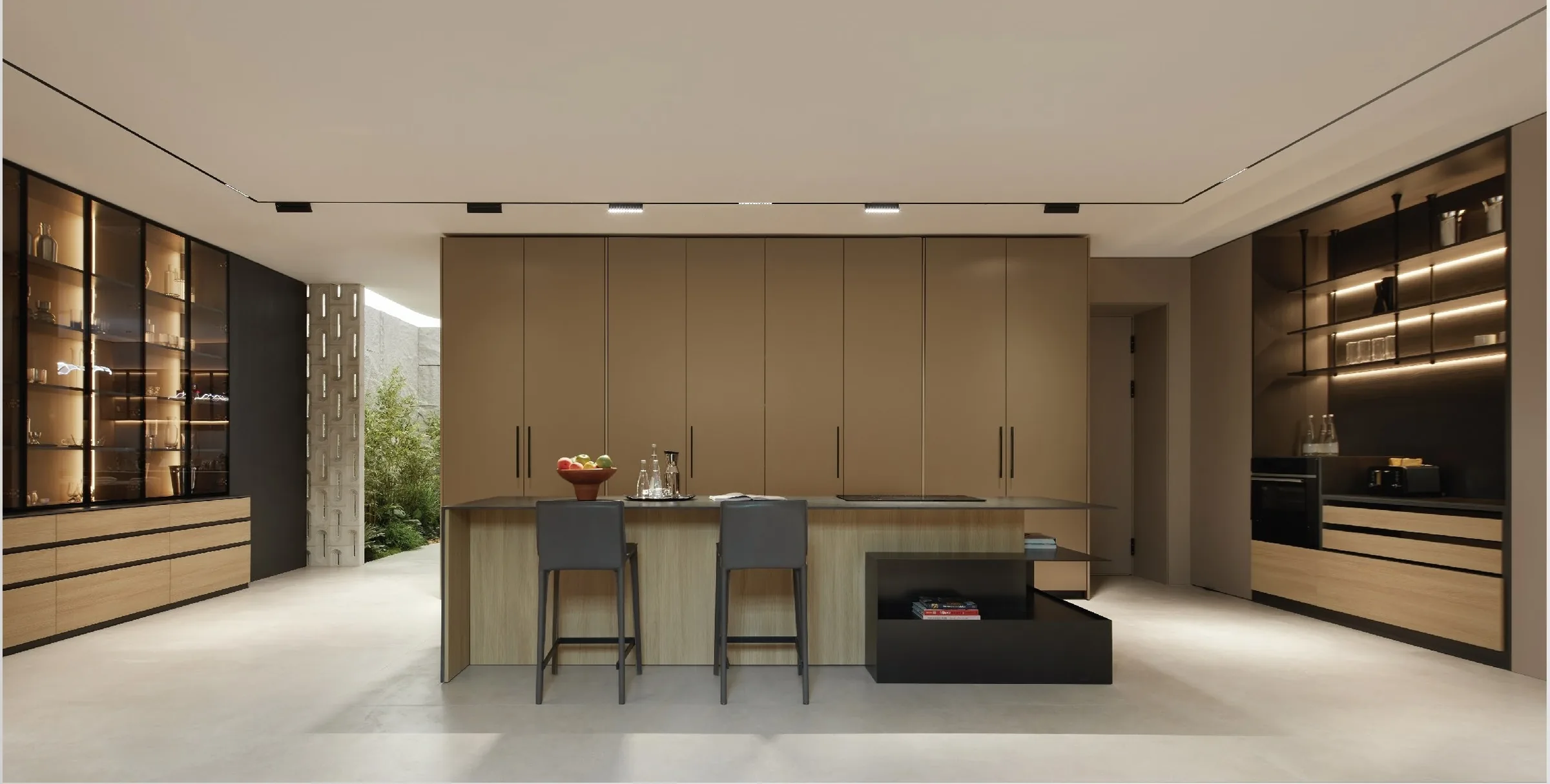
Hardware: the specification that has to exist before the quote
Brand and series decide door thickness, drilling and price. A quote without them is a range, and the range is where projects get lost.
Hinges, runners, lift systems, handles — the hardware schedule decides the door thickness, the carcass drilling pattern and the price. A quote without it is a range, not a price.
On a soft-close runner the tolerance is a millimetre or two; on a cheap one the drawer drops after a year and the client blames the cabinet. Specify the brand and the series, not just 'soft close'.
We list hardware by function: hinge (with opening angle), runner (with load), lift (with stay force), handle (with finish). If a substitution is made it is shown as a substitution, in writing.
What should a buyer send so the hardware schedule can be built?
The schedule is built from the buyer's own inputs, not from the factory's assumptions. Start with the function list: every door, drawer and lift position, and what it is expected to do. A door that only opens is a different entry from a door that must hold open at an angle, and a drawer that carries light goods is a different entry from one that carries heavy goods. Mark each position on the elevation so the schedule and the drawing refer to the same item.
Then supply the constraints the hardware has to live with: the door thickness, the carcass material and the drilling pattern already agreed, and the handle finish. Where a brand or series is required, name it; where the buyer has no preference, say so explicitly so the factory can propose and the proposal can be reviewed as a proposal. Anything left blank comes back as an assumption, and an assumption in a quote is a range again.
How do I compare two hardware quotes that look the same?
Compare line by line against the schedule, not against the total. Two quotes can both say soft close and still differ on every position: one names the brand and series, the other names a function. Put the two documents side by side and check that each hinge entry carries its opening angle, each runner entry carries its load, each lift entry carries its stay force, and each handle entry carries its finish. A missing attribute is not a saving; it is an open question.
Then look at how substitutions are handled. A quote that shows a substitution in writing, against the named item, can be assessed. A quote that quietly lists a different series under the same function cannot. The comparison is finished when every position in the schedule has a named item in both quotes and the differences are visible without asking.
What are the common mistakes when specifying hardware?
The most common mistake is specifying by function alone. Soft close is a behaviour, not a specification; without the brand and series the factory is free to choose, and the tolerance the buyer cares about is not protected. The second is leaving the opening angle, load or stay force off the entry, so the item cannot be checked on delivery or compared between quotes.
Another is letting a substitution pass verbally. If it is not shown as a substitution in writing, it becomes the new baseline and the next order inherits it. Buyers also forget that hardware drives the door thickness and the carcass drilling pattern; a hardware change made late forces those to change too. Finally, a schedule that is not tied to the elevation leaves positions unaccounted for, and unaccounted positions are where the cheap item ends up.
Start with
a brief.
Send the drawings and the room list. We will come back with a scope, a finish schedule and a price range.